Our Live Online Courses are Now Live! Learn More


This course offers a comprehensive, hands-on introduction to data analytics, data visualization, and Business Intelligence, with a strong practical focus on Microsoft Power BI. Designed for beginners and early-career professionals, the course is structured in three progressive parts that move learners from foundational concepts to advanced, tool-based application.
In Part I: Introduction to Data Analytics, learners build a strong conceptual foundation by understanding what data analytics is, where it is used, and why it matters for decision-making. This part covers the analytics lifecycle, types of analytics, key analytics roles, and essential data concepts, including data types, databases, and the basics of SQL. By the end of Part I, learners are able to interpret how raw data is transformed into insights across real-world contexts.
In Part II: Data Visualization, learners focus on turning data into clear, meaningful insights through effective visual communication. This part explores when and why visualizations are more powerful than raw data, how human visual perception influences interpretation, and how to design charts and dashboards that are accurate, accessible, and decision-focused. Learners develop the ability to evaluate visualizations critically, avoid misleading designs, and apply best practices for dashboard design.
In Part III: Data Analytics and Visualization Tools – Power BI, learners apply everything they have learned using Microsoft Power BI. This is the most applied and hands-on part of the course, where participants work through the full Business Intelligence workflow. Learners clean and prepare data using Power Query, build robust data models, create calculated columns and measures using DAX, and design interactive, well-structured reports and dashboards. The course also covers publishing, sharing, and securing reports using Power BI Service, ensuring learners understand how insights are delivered in real organizational settings.
Through a combination of video lessons, practice exercises, graded assessments, live sessions, and real-world examples, learners gain the skills to analyze data, design impactful visualizations, and communicate insights confidently. By the end of the course, participants are well-prepared to work with data in professional contexts, showcase Power BI projects, and take next steps toward certifications and data-focused career opportunities.
By the end of this course you will walk away with:
Want to avail group discounts? Visit our “For Organizations” page to learn more about team enrollments.
This course is also offered in the Self-Paced Format where you can learn at your own pace. Learn More


Shazeb Ali is a data and AI strategist with over eight years of experience across…
Shazeb Ali is a data and AI strategist with over eight years of experience across…
Suleman Shahid is an Associate Professor of Computer Science at the Lahore University of Management…
Suleman Shahid is an Associate Professor of Computer Science at the Lahore University of Management…
In this module, learners are introduced to the fundamentals of data analytics and how it drives decision-making across industries. They explore what data analytics is, where it is used, and how raw data moves through the analytics lifecycle. The module also introduces analytics roles, common data types, and basic database concepts, laying the groundwork for the rest of the course.
Learning Outcomes:
This module focuses on how data is structured, collected, and stored for analysis. Learners explore different data types and gain a conceptual understanding of databases and relational structures. The module introduces SQL as a way to retrieve data and connects database concepts to practical, real-world use cases.
Learning Outcomes:
This module introduces the purpose and value of data visualization. Learners explore when to use charts instead of tables, how visualizations reveal patterns, and how to select appropriate chart types to support analysis and decision-making.
Learning Outcomes:
This module examines how visual encoding and human perception affect interpretation. Learners analyze visual channels like color, size, and position, and apply design principles to improve clarity, accuracy, and accessibility.
Learning Outcomes:
Learners focus on dashboard design and common visualization pitfalls. The module introduces the Focus Framework and teaches learners how to identify misleading visuals and recommend improvements for clarity and trust.
Learning Outcomes:
This module introduces Business Intelligence and its role in analytics. Learners explore BI concepts, ETL processes, self-service analytics, and leading BI tools and trends.
Learning Outcomes:
Learners get hands-on with Power BI Desktop, exploring the interface, views, and data connections. The module builds confidence in navigating the tool and preparing datasets for analysis.
Learning Outcomes:
This module focuses on cleaning and transforming data using Power Query. Learners perform common transformations and prepare clean datasets for accurate analysis.
Learning Outcomes:
Learners explore DAX to create calculations and measures in Power BI. The module introduces contexts, time intelligence, and logical expressions for deeper analysis.
Learning Outcomes:
This module focuses on building robust data models. Learners design star schemas, manage relationships, and create hierarchies to support scalable reporting.
Learning Outcomes:
Learners explore publishing, sharing, and securing reports in Power BI Service, ensuring insights reach the right stakeholders safely.
Learning Outcomes:
In this live session, learners receive guidance on PL-300 certification and professional positioning. The session focuses on showcasing Power BI projects and preparing for career opportunities.
Learning Outcomes:
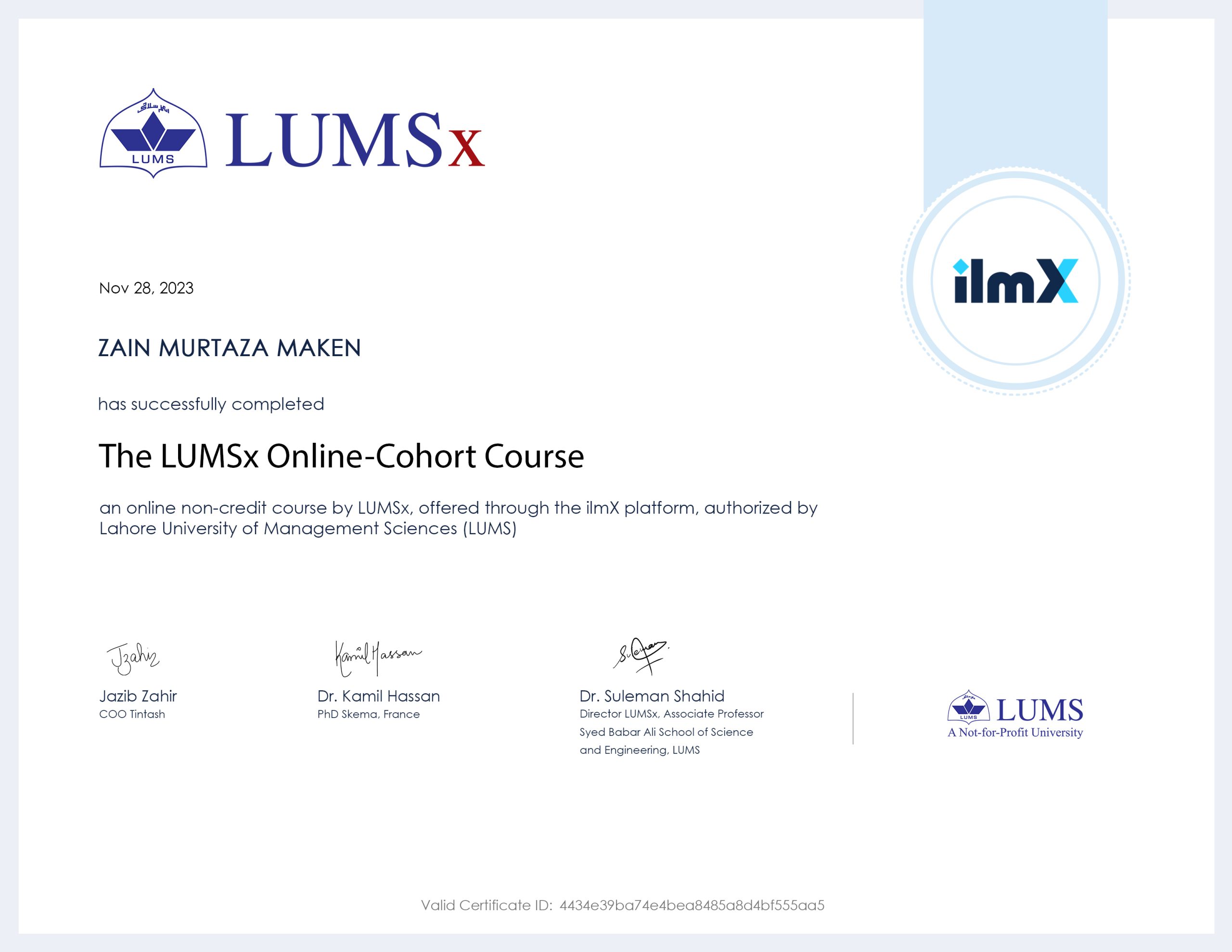
Upon completion of the course, you receive a signed certificate from the institute. You can share this certificate in the certifications section of your LinkedIn profile, on printed resumes, CVs, or other documents.
When you click on the Enroll Now button, you will be asked to register online. Once you have completed your online registration, you will proceed to the payment section where you can choose from three options:
1. Pay via bank: You will be able to instantly download a fee voucher for hassle-free bank deposits. After your payment is confirmed, you will receive an email within 24 hours, granting you access to our learning management system.
2. Pay online: By opting for ‘Pay Online’, a voucher will be automatically generated with a simple click to swiftly complete the payment. After your payment is confirmed, you will receive an email within 24 hours, granting you access to our learning management system.
3. Pay in instalments: LUMSx is an official partner of the KalPay Taleem team, which offer an instalment facility for learners. If you would like to avail this option, please complete the online registration form and select the option ‘Pay in instalments’. For more information, contact taleem@kalpayfinancials.com or call at 0328 3044414
This course is designed for learners who want to build practical, job-ready skills in data analytics, visualization, and business intelligence. It is ideal for aspiring data analysts, early-career professionals, and students looking to understand how data is used to inform decisions across industries.
Whether you are new to data analytics or looking to strengthen your analytical and visualization skills, this course provides a structured pathway—from foundational concepts to hands-on work with Power BI. It is also well suited for professionals preparing for Power BI certification or anyone seeking to communicate insights more effectively using data.
No formal prerequisites are required. Learners should be comfortable using a computer and working with basic tools such as spreadsheets. Prior exposure to data, statistics, or analytics tools can be helpful, but all core concepts—including SQL, data visualization, and Power BI—are introduced step by step within the course.
Yes, this course is entirely online.
A cohort course combines elements of both asynchronous learning (through pre-recorded videos and materials that you can access at your own pace) and synchronous learning (live classes and interactive sessions scheduled at specific times).
The live classes provide an opportunity for real-time interaction with the instructor and peers, discussion of course material, clarification of doubts, and engaging in interactive learning activities.
Participants will find all necessary reading materials and assignments on the LUMSx Learning Management System (LMS). Access to the LMS will be granted upon completion of the enrollment process for the workshop. It is important to note that course materials will be made accessible in the week leading up to the commencement of the workshop, ensuring participants have ample time to familiarize themselves with the content before the official start.
While discussion and collaboration with peers is encouraged to foster a learning community, sharing or copying code/solutions is strictly prohibited. Any collaboration should be limited to discussing concepts and should not involve sharing actual code or solutions.
You have to score at least 70% to pass this course.
Yes, you will get a certificate at the end of this course.
No, you must watch all the videos and attempt all the assessments to get a course certificate.
Please forward any queries to our team on the chat widget or email your query to us at support@ilmx.org. We will only be responding to technical support queries. Content related queries cannot be entertained at the moment.
Get early access by joining the waitlist!

Get early access by joining the waitlist!
Get early access by joining the waitlist!
Get early access by joining the waitlist!