

Every successful business begins with an idea, but turning that idea into a viable venture takes more than enthusiasm. Entrepreneurship 101: From Idea to Pitch is a six-week online course that takes you through the full journey of an early-stage venture. You begin by understanding the people you want to serve and the problem you want to solve. You then shape that idea into a business model, plan how to reach your customers, protect your venture legally, and work out the numbers behind it. Finally, you learn to present it all in a confident, persuasive pitch.
The course combines self-paced, pre-recorded lessons with six live sessions with instructors: one on the Business Model Canvas, four for the Entrepreneurial Finance module, and a closing session on pitching. In the finance sessions, you’ll be guided step by step to build a simple financial plan for your own business idea, including a 12-month cash-flow forecast, and use AI tools to test and refine it. Along the way, you’ll answer the questions every founder must face: How much money do I need to start? When will the business become cash-flow positive? Which assumptions matter most? Is this idea worth pursuing? No prior finance experience is needed.
Along the way, you will develop your own Business Model Canvas and build a pitch deck for your idea. By the end, you will have a clearer picture of who your business serves, how it creates value, how it makes money, how much capital it needs, and how to communicate that vision to others.
This course is designed for aspiring entrepreneurs at the pre-incubation stage: people who have a business idea, or the drive to start one, but haven’t yet launched a venture. It suits students, young professionals, and career changers who want a practical, structured introduction to building a business. No prior business experience or formal training is required.
Want to avail group discounts? Visit our “Partnerships” page to learn more about team enrollments.
This course is also offered in the Self-Paced Format where you can learn at your own pace. Learn More






Dr. Suleman Shahid is an Associate Professor in the Department of Computer Science at the…
Dr. Suleman Shahid is an Associate Professor in the Department of Computer Science at the…
Dr. Shehryar Shahid is an Associate Professor of Entrepreneurship at Suleman Dawood School of Business…
Dr. Shehryar Shahid is an Associate Professor of Entrepreneurship at Suleman Dawood School of Business…
Amin Piracha is the Chief Operating Officer at Treet Battery, where he leads business operations,…
Amin Piracha is the Chief Operating Officer at Treet Battery, where he leads business operations,…
Barrister Ahmed Uzair is a distinguished legal expert with over a decade of experience as…
Barrister Ahmed Uzair is a distinguished legal expert with over a decade of experience as…
Muhammad Fahad Tanveer is Co-Founder and CEO of Edkasa, an education technology company focused on…
Muhammad Fahad Tanveer is Co-Founder and CEO of Edkasa, an education technology company focused on…
Atif Rahim Khan, SPHR boasts over two decades of experience in executive education, coaching, consulting,…
Atif Rahim Khan, SPHR boasts over two decades of experience in executive education, coaching, consulting,…
In this module, you will explore Design Thinking — a creative, human-centered approach to solving problems and developing innovative solutions. You will learn how entrepreneurs use empathy, research, ideation, prototyping, and testing to better understand user needs and design meaningful products, services, and experiences.
Through recorded lectures and practical examples, this module will guide you through the five stages of Design Thinking: Empathize, Define, Ideate, Prototype, and Test. You will also learn how to frame clear problem statements, generate creative ideas, develop prototypes, and use feedback to improve solutions through iteration. By the end of this module, you will be able to approach challenges with a user-focused mindset and apply Design Thinking principles to real-world entrepreneurial contexts.
Learning Outcomes
By the end of this course, participants will:
This module introduces Entrepreneurial Strategies for startups. It explores the fundamentals of entrepreneurial strategy, focusing on tools and frameworks that help organizations navigate challenges, identify opportunities, and achieve sustainable success. Participants will learn how to analyze competitive landscapes, apply innovative strategies like the Blue Ocean strategy, and leverage Lean Startup principles for agile decision-making. The lessons are designed to provide practical insights through case studies and class discussions.
The module will equip participants with the skills and knowledge to craft strategies that drive growth and create long-term value in dynamic business environments.
Learning Outcomes
By the end of this course, participants will:
This module introduces Marketing Strategies for Entrepreneurship. Marketing is a critical function for startups, enabling them to establish their brand presence, attract customers, and drive growth despite resource constraints. The module introduces participants to essential marketing concepts, including brand positioning, customer segmentation, and content marketing strategies.
By leveraging industry best practices and real-world case studies, participants will develop actionable marketing strategies tailored to their startup’s needs. The module also emphasizes the importance of digital marketing, data-driven decision-making, and performance measurement.
Learning Outcomes
By the end of this course, participants will:
This module introduces key legal considerations for entrepreneurs, covering business structures, intellectual property, compliance, contracts, and investment agreements. Participants will gain practical knowledge on how to legally protect their business, navigate regulations, and avoid common legal pitfalls.
Through worked examples and case-based scenarios drawn from real startup situations, learners will see how these legal concepts apply in practice. With a focus on the challenges startups commonly face, the module examines how businesses are structured, how intellectual property is protected, and how investments are raised and negotiated while maintaining legal compliance. By the end, participants will be able to recognize the key legal considerations that support sustainable business growth and identify the risks that most often affect early-stage ventures.
Learning Outcomes
By the end of this course, participants will:
This module introduces the financial side of starting a business, designed for aspiring entrepreneurs with little or no prior finance knowledge. Rather than teaching finance as an accounting subject, it focuses on the practical questions every founder needs to answer at the start of a venture: Is this business worth pursuing? How much cash will it require? When might it run out of cash? Which assumptions drive its economics, and what should a founder be ready to discuss with an investor?
Unlike the other modules, Entrepreneurial Finance is delivered live across four interactive sessions, building step by step from idea to investment decision. Participants begin by exploring how a business makes money, covering revenue, costs, margins, and the difference between profit and cash. They then focus on cash flow, learning how to plan for cash coming in and going out, and how slower sales, higher costs, or late payments can affect a young business. The third session connects these numbers to decision-making and funding, introducing the time value of money, the choice between bootstrapping and external financing, and what investors look for in a startup’s numbers. In the final session, participants use AI tools to test and validate their financial model, then refine it to present a stronger case to investors. Throughout the module, participants apply each concept to their own business idea, working toward a simple 12-month cash-flow forecast that gives them a clear financial picture of their venture.
Learning Outcomes
By the end of this course, participants will:
This module equips aspiring entrepreneurs with the skills to prepare and deliver compelling pitches. It focuses on both content preparation and presentation delivery—helping participants identify and frame their core value proposition, understand their customer, structure their pitch, and deliver it with confidence. Through guided practice, storytelling tools, and proven communication techniques, participants will learn to create impactful pitch decks that resonate with stakeholders, investors, and potential partners.
Learning Outcomes
By the end of this course, participants will:
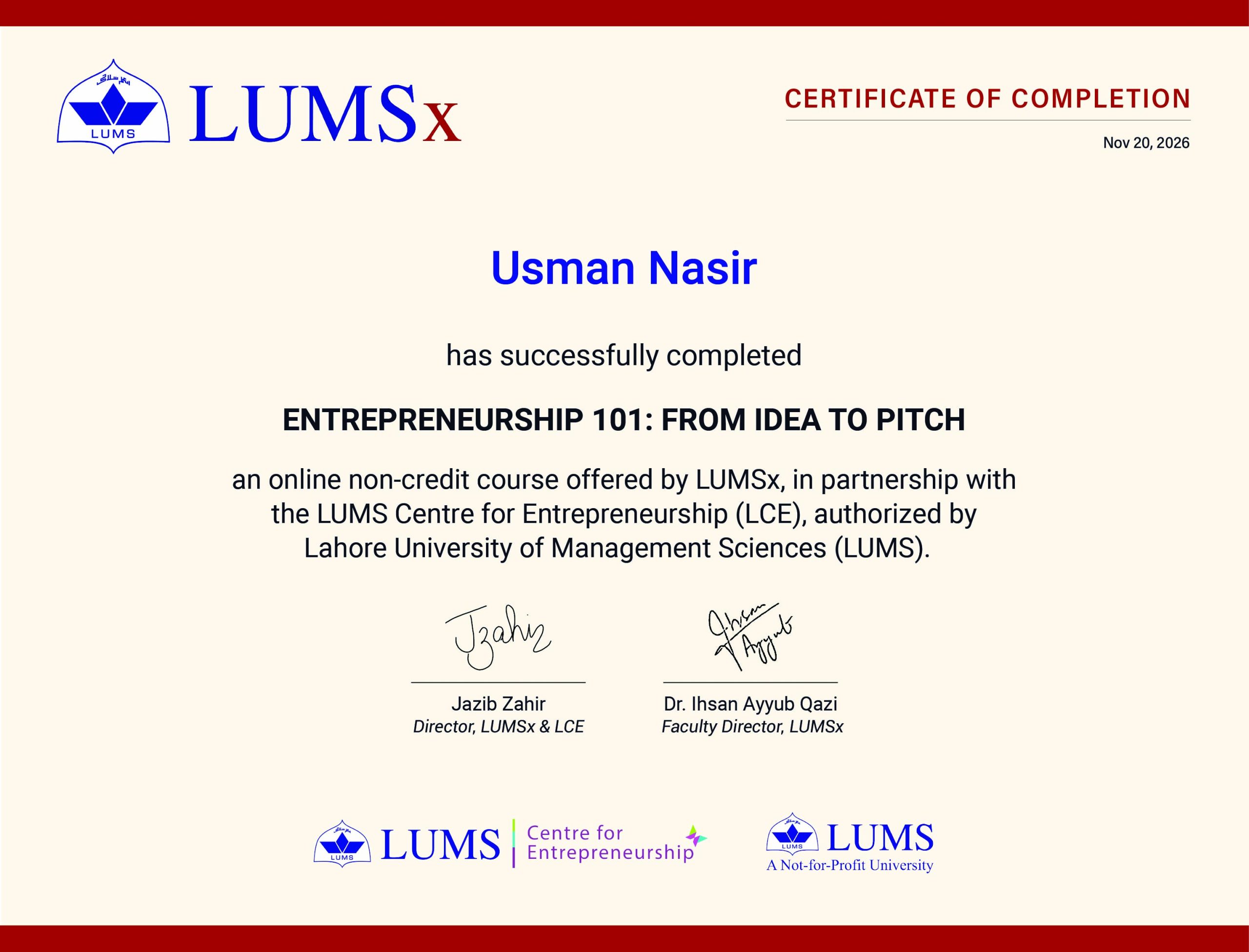
Upon completion of the course, you receive a signed certificate from the institute. You can share this certificate in the certifications section of your LinkedIn profile, on printed resumes, CVs, or other documents.
This course is designed for aspiring entrepreneurs at the pre-incubation stage: people who have a business idea, or the drive to start one, but haven’t yet launched a venture. It suits students, young professionals, and career changers who want a practical, structured introduction to building a business. No prior business experience or formal training is required.
This is a 6-week online course offered in a cohort-based format. It combines short, pre-recorded video lessons with real-world case studies, knowledge checks, and practical tasks, including developing your own Business Model Canvas and Pitch Deck. The course also includes six live sessions: a Business Model Canvas session, four interactive sessions for the Entrepreneurial Finance module, and a closing pitch session. A new module opens each week, and you can watch its recorded lessons at any time that suits you during that week. The live sessions take place on scheduled dates for discussion, guidance, and hands-on practice.
You should plan for around 5 to 6 hours per week to watch the lessons and complete the tasks, plus time for live sessions in the weeks they take place. The Entrepreneurial Finance week requires more time, with four live sessions accounting for 7 hours.
No, this course is designed for beginners, so no prior business or finance experience is needed. Having a business idea in mind will help, since you’ll apply what you learn to your own idea throughout the course. If you’re still shaping your idea, the Design Thinking module will help you get started.
No. The Entrepreneurial Finance module assumes no prior finance knowledge, and you’ll be guided step by step. A basic familiarity with spreadsheets will be helpful.
This course is designed to help you build the foundations, such as a Business Model Canvas, a financial plan, and a pitch, that incubation programs typically look for. Completing it does not guarantee admission to any incubation program.
Participants should have access to a laptop, computer, or tablet with audio capability and a stable internet connection. The course will use platforms such as Zoom or Microsoft Teams for the live sessions. Basic familiarity with online learning platforms will help ensure a smooth learning experience.
Yes. Upon successful completion of all course requirements and assessments, participants will receive a certificate from LUMSx.
Yes, a printed certificate is available for an additional fee. Instructions for requesting one will be shared at the end of the course.
If the course is cancelled or postponed due to insufficient enrollment or unforeseen circumstances, a refund will be provided for registration or processing fees paid. Refunds will not be issued if a participant chooses to withdraw voluntarily after enrollment.
No. Participants are expected to complete all modules, videos, and assessments to meet the learning requirements and qualify for a certificate, unless an activity has been marked as optional.
Our course team will guide you throughout the course, helping you with course requirements, deadlines, and any questions about the learning journey. Technical support is also available if you run into any issues accessing the course platform or live sessions. The live sessions with the instructors provide an additional space for discussion, clarification, and hands-on guidance.
If you are unable to join the current cohort, please check the website for upcoming cohorts. This course will be offered multiple times, allowing you to register for a schedule that best suits you.
Yes. Universities, incubators, and other organizations may request a dedicated cohort tailored to their needs. Please contact contactlumsx@lums.edu.pk with your proposal, and a representative will reach out to discuss customization options and scheduling.
When you click on the Enroll Now button, you will be asked to register online. Once you complete registration, you can choose from three payment options:
1. Pay via bank: Instantly download a fee voucher for hassle-free bank deposits. After payment confirmation, you’ll receive access to the learning management system within 24 hours.
2. Pay online: Generate a voucher with a single click and complete payment swiftly. Access is granted within 24 hours of confirmation.
3. Pay in installments: LUMSx partners with KalPay Taleem to offer installment options. Complete registration and select “Pay in installments.” For more info, contact taleem@kalpayfinancials.com or call 0328 3044414.
Get early access by joining the waitlist!

Get early access by joining the waitlist!
Get early access by joining the waitlist!
Get early access by joining the waitlist!